
How to price your POD products for the German market
A practical guide covering how to price your pod products for the german market — pricing strategy and margin optimization.
Why this matters for sellers
Pricing is where marketplace selling gets brutally honest. The topic of "How to price your POD products for the German market" matters because most sellers underprice their products — not because they want to, but because they are afraid. Afraid of no sales, afraid of losing to cheaper competitors. This fear leads to a trap: you sell more units, work harder, and make less money per hour.
Understanding margin math and pricing psychology breaks that trap.
Understanding the margin stack
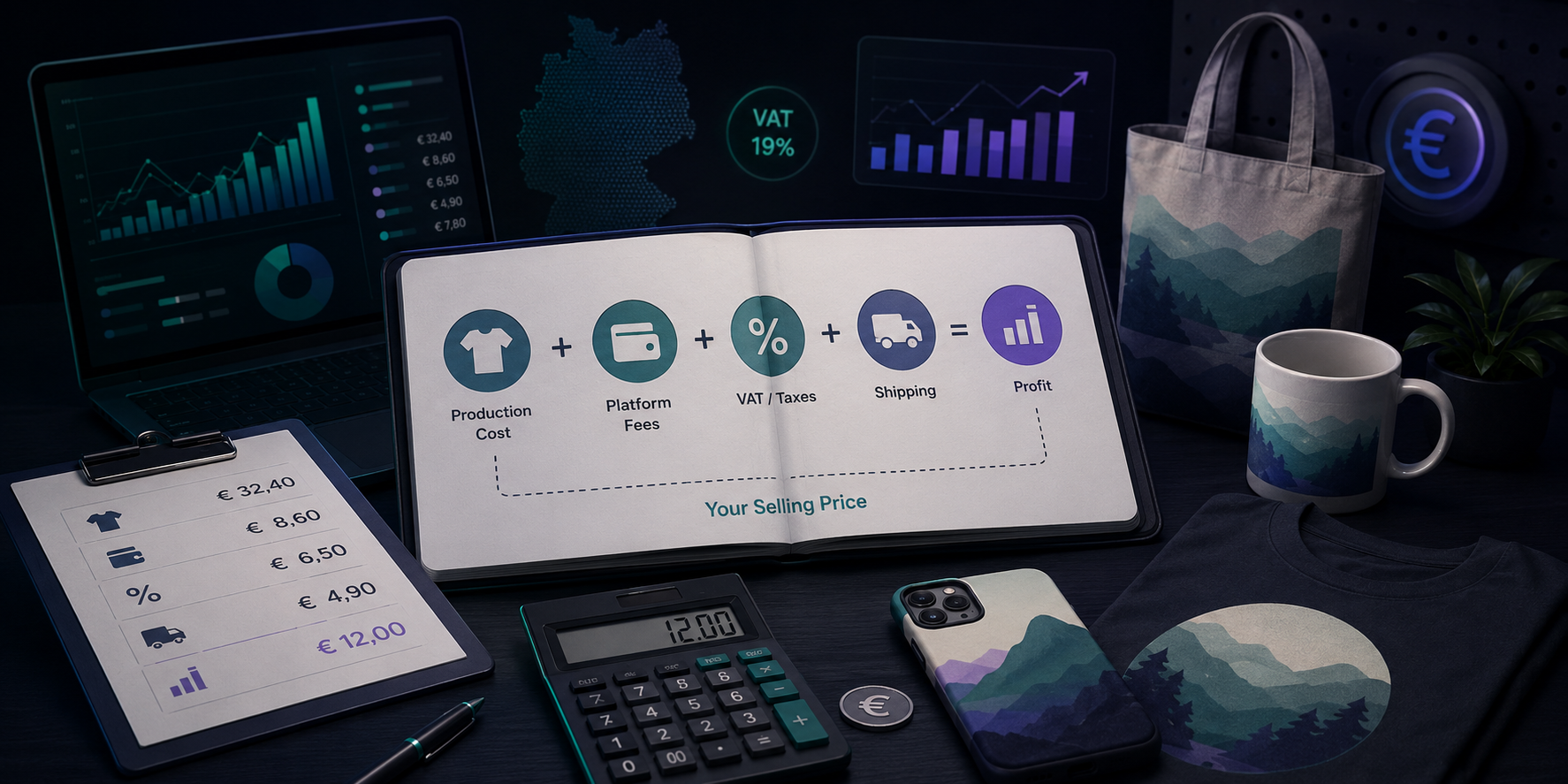
Every POD product has a margin stack — the layers of cost that sit between the retail price and your profit. Before setting a price, know your full stack:
- **Base production cost**: What the POD supplier charges to print and ship the item.
- **Platform fees**: Transaction fees, listing fees, and payment processing fees typically total 12-25% of the sale price depending on the platform.
- **VAT and taxes**: In the EU, VAT applies to goods sold to European buyers. Know your obligations before scaling.
- **Advertising costs**: If you run promoted listings or external ads, include cost-per-sale in your margin calculation.
- **Your time**: Design time, order management, customer service. Often ignored, always real.
What remains after all of these is your actual profit per unit.
A step-by-step pricing approach
Step 1 — Calculate your true cost per order: Sum up production cost, platform fees, average shipping contribution, and estimated ad spend per order. This is your break-even point. Never set your price anywhere near this number.
Step 2 — Set a minimum acceptable margin: For POD sellers, a 40-60% gross margin before time and advertising costs is a reasonable baseline. If the market price for your product type does not support that margin, change the product or the category.
Step 3 — Research competitive pricing: Look at the top 20-30 listings in your niche. Note the price distribution — the lowest, median, and highest prices. Where the best-converting listings cluster tells you where buyers have set their expectations.
Step 4 — Price at or slightly above the median: Undercutting on price is rarely sustainable in POD. You cannot out-price a supplier-integrated competitor. Instead, position at the median or slightly above, and compete on perceived quality, specificity, and presentation.
Step 5 — Test price sensitivity: Run your listing at your initial price for 30 days. If you have high impressions but low conversion, check photos and description first before adjusting price. If you are selling consistently, test 10-15% higher to see if conversion holds.
Common mistakes to avoid
Matching the lowest price in the market is a race to the bottom. The cheapest listing often has the worst photos, the weakest copy, and the lowest conversion rate. Matching that price signals low quality to buyers who look at the full listing.
Not accounting for chargebacks and refunds erodes margin. Even a small refund rate of 1-3% significantly impacts low-ticket item margins. Build a small buffer into your pricing.
Try it in Nexpilot
Use Open Profit Calculator in Nexpilot to model your margin stack across platforms and find your optimal price point before listing.
**Disclaimer:** All scores and signals in Nexpilot are based on rules-based analysis — not official marketplace data. Use them as directional guidance, not as guarantees of results.