
How to plan a small collection around one buyer persona
A practical framework for turning one clearly defined buyer persona into a focused, visually consistent POD collection that can be tested before expanding.
Why this matters for sellers
Many POD sellers build collections backwards. They choose several unrelated products, apply similar designs, and only later try to work out who might buy them.
A stronger approach starts with one clearly defined buyer persona.
When every product is created for the same type of buyer, the collection becomes easier to understand, easier to present, and more likely to generate multiple purchases. The products feel connected because they share the same audience, visual direction, use case, and emotional appeal.
A small focused collection also reduces risk. Instead of creating dozens of listings based on an untested idea, you can launch 8–12 coordinated products, measure buyer response, and expand only after finding evidence of demand.
Understanding the buyer persona
A useful buyer persona is more specific than a broad audience such as “dog owners”, “teachers”, or “book lovers”.
For example, “dog owner” describes a large market. “First-time puppy owner looking for personalized home accessories and gifts” describes a more useful commercial target.
Define the persona using a few practical characteristics:
- **Identity:** Who is the buyer and how do they describe themselves?
- **Motivation:** Are they buying for themselves, decorating a space, celebrating an event, or choosing a gift?
- **Product preferences:** Do they value personalization, humor, minimal design, premium materials, or affordability?
- **Buying occasion:** Is the purchase connected to a birthday, new pet, wedding, holiday, profession, hobby, or milestone?
- **Price sensitivity:** Are they looking for a small impulse purchase or a more meaningful premium product?
The goal is not to create a fictional biography. It is to identify enough shared needs and preferences to guide product decisions.
A step-by-step collection planning approach
Step 1 — Define one specific buyer persona:
Choose a narrow audience with a recognizable need. For example: first-time puppy owners, minimalist home-office workers, new teachers, or hikers looking for personalized gifts.
Step 2 — Choose one central collection theme:
Build the collection around one emotional or practical idea. This could be belonging, celebration, identity, organization, humor, remembrance, or personalization.
Step 3 — Establish a consistent visual direction:
Define the color palette, illustration style, typography approach, tone, and level of personalization before creating individual products. The collection should feel connected without repeating the exact same design.
Step 4 — Select a balanced product mix:
Choose products that suit different buying situations and price points. A small collection might include one hero product, several affordable entry products, two gift-oriented items, and one premium option.
Step 5 — Adapt the concept to each product:
Do not place the same artwork on every item without adjustment. Consider how the buyer will use each product and adapt the design, layout, message, or personalization accordingly.
Step 6 — Create 8–12 initial listings:
This is usually enough to present a clear collection while keeping the test manageable. Avoid creating 30 or 40 products before receiving any real buyer signals.
Step 7 — Validate before expanding:
Monitor impressions, clicks, favorites, conversion, product combinations, and customer questions. Expand the products and visual angles that receive attention, and remove weak variations.
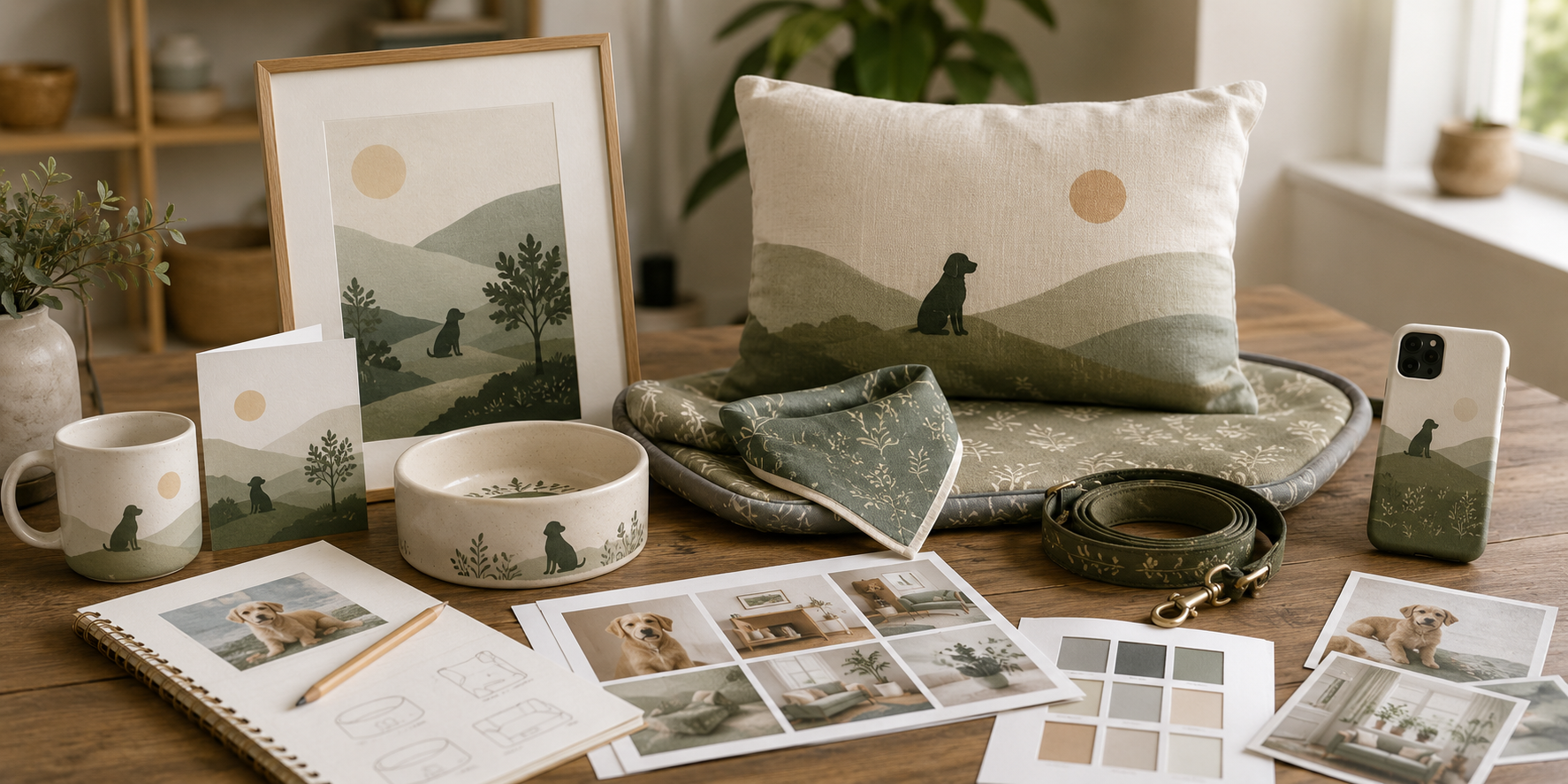
Example: a collection for first-time puppy owners
A focused collection could include:
- a personalized feeding mat;
- a name-based dog bowl;
- a puppy milestone notebook;
- a custom wall print;
- a washable pet blanket;
- a collar tag design;
- a welcome-home card;
- a personalized phone case;
- a seasonal ornament;
- a premium gift bundle.
The products are different, but they serve the same buyer, use the same visual language, and connect to the same emotional moment: welcoming a new dog into the home.
Common mistakes to avoid
Creating products for several unrelated audiences weakens the collection. A design for teachers, another for dog owners, and another for hikers may work as separate listings, but they do not create a coherent product range.
Repeating the same design on every product is not the same as building a collection. Each item should have a clear role and feel appropriate for its format.
Choosing products before understanding the buyer often leads to random assortments. Start with the person and the buying occasion, then choose products that fit naturally.
Expanding too quickly creates unnecessary work. Test a small collection first and use real listing performance to decide what to create next.
Focusing only on visual consistency can also be a mistake. A collection must be commercially coherent, not just aesthetically similar. The products should solve related needs for the same buyer.
Key takeaways
Start with one specific buyer, one central need, and one clear visual direction.
Build a small collection of 8–12 products with different functions and price points rather than repeating the same artwork across unrelated items.
Treat the first collection as a structured market test. Use buyer response to decide which products, messages, and visual concepts deserve expansion.
A focused collection is easier to position, easier to promote, and more useful for understanding what your audience actually wants.
Try it in Nexpilot
Use Find Opportunities in Nexpilot to research buyer-focused niches, compare product angles, and identify signals worth validating before building a complete POD collection.
**Disclaimer:** All scores and signals in Nexpilot are based on rules-based analysis — not official marketplace data. Use them as directional guidance, not as guarantees of results.